Episode Transcript
The Finance Ghost: Welcome to this episode of the Finance Ghost Plugged in with Capitec. And in fact, it's not just welcome to this episode, it's welcome to this season!
Because this is season two - I'm thrilled to report that I will be working with Capitec on another season of this wonderful podcast, where we get to expose people to some of the fantastic entrepreneurs in the broader Capitec ecosystem, and also some of the very important partners and people just making things happen.
Today we are speaking to someone who is both an entrepreneur and a partner to Capitec. So this is going to be a particularly interesting conversation.
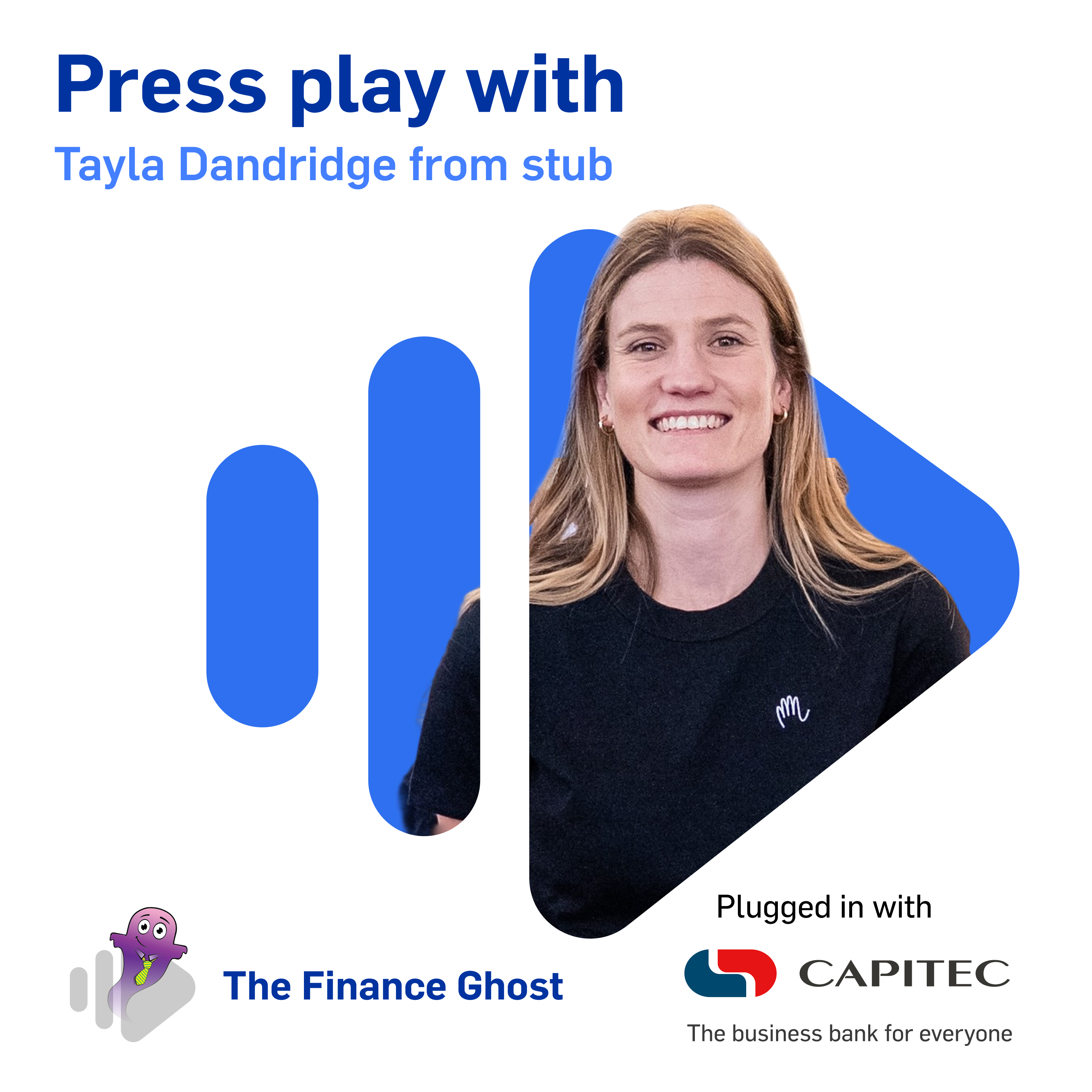
That is Tayla Dandridge. She is the co-founder of stub. Tayla, thank you so much for your time joining me from Joburg and I'm very excited to dig into the story with you.
Tayla Dandridge: Thank you so much, Ghost. I'm so excited to be here.
The Finance Ghost: So, interestingly enough, accounting software startups are quite thin on the ground. I think when people talk about IT startups, things like fintechs come up a lot, and lots of payments businesses and all that kind of thing always seem to feature.
But you're not building one of those. You are building an accounting software startup, and there are some serious whales in that market that you are up against, right? It's QuickBooks, Xero, it's Sage, and a lot of others. It’s a tough game to actually break into.
How and why did you actually set out on this journey? When you were in school and they asked you what you wanted to be when you grew up, did you say, “I want to be an accounting software nerd”? Probably not. How did you get here, Tayla?
Tayla Dandridge: It's a question on everybody's lips. And I think most people don't wake up in the morning and think, “sheepers, today I want to build accounting software”. And to be honest, it didn't necessarily start that way for us either.
Stub was actually started at the back of a shuttle in the Joburg central business district (CBD). We were surrounded by loads of everyday businesses. So think of your spazas, your traders, your service providers.
And with the continuous stat that around 80% of small businesses are failing in South Africa, it was obvious to us that it was a market that was being massively underserved, and we wanted to do something about it.
If you think about the whales that you mentioned, they’re built for a different kind of customer. Their customer is the accountant or someone who has a strong financial or finance background. And that’s for us where the opportunity sits.
If you think of some of the global players in this space, if you think of maybe not this space in particular, but some of the fintechs that are doing epic things overseas, like Monzo or Revolut - they didn't necessarily come into the market and just think, “Let's do something slightly better than the high-street banks”. They came and did something fundamentally different - and that's what excited us at stub.
In verticals where they are whales, there's almost always a massive underserved layer - and that's the market that we’re building for.
The Finance Ghost: That is very cool. I love the way you're thinking about this, and you've raised a point that I wanted to bring up later, but let's touch on it now.
This concept of when you are disrupting, as we say, “whales” - very big, scary things in the ocean (well, not that scary, but they can be) - you need to be quick and you need to be smart, and you need to dart around them, and you need to do things that are fundamentally different, as you say. I think Revolut's a great example.
From a product perspective, you've talked about how stub is built for entrepreneurs rather than for accountants. And as someone who uses QuickBooks, and I am a Chartered Accountant by profession, I can absolutely understand what you're saying - you go into something like QuickBooks, and I would imagine if you have no accounting background, that's a very scary thing to be logging into and trying to understand.
You're very much in the hands of your accountant, and they know that, which is why they distribute through accountants to such a large extent over at Intuit (owner of QuickBooks).
In your world, you are targeting business owners, and that means that stub is probably built quite differently to some of these names. So from a product perspective, what actually makes stub different? When you say you've built it for entrepreneurs, what does that mean?
Tayla Dandridge: Well, firstly, Ghost, before we carry on, hopefully by the end of this podcast, you'll be a new stub customer. That's the goal.
The Finance Ghost: I was waiting for you to upsell me on stub. I knew it.
Tayla Dandridge: Yeah!
The Finance Ghost: You wouldn't be an entrepreneur if you didn't attempt to pitch me. That's key.
Tayla Dandridge: Definitely! That's going to be on my 2026 KPIs - move Ghost over to stub.
But when we think about product, and we think about building technology, and we think about how we do things differently at stub, there are three things.
The first thing, and top of my list, and something I fight for on a daily basis, is around simplicity. So how do we make sure that stub is incredibly simple and easy to use, and that it's a fantastic customer experience?
It shouldn't feel like a hack, and it shouldn't feel like it's a tax on your time. So, how do you get on and get genuinely excited to use your accounting software? That's a challenge in itself.
The second thing, and probably quite a high priority item on most people's lips at the moment, is around intelligence. So how do we make sure that stub does the work for you?
And there we're talking about real time reconciliation, automated insights, focusing on eliminating the admin that entrepreneurs really shouldn't be doing. They don't have time for that stuff.
And third, but definitely not least important, and something that we’re incredibly passionate about, is: how do we build localisation? How do we ensure that there are deep integrations and functionality for the markets we serve, considering both price and functionality?
So if you think about our whales and our incumbents, they weren't built for the trader in Durban. We are.
The Finance Ghost: Yeah, I like that. Local businesses for local solutions.
I just want to understand a bit more about the team behind this, and where you guys actually sit, because I know that you split your time to a large extent between London and South Africa, so you kind of bring that global lens to it as well, which I think is important.
And it's not just you who's built this thing. As I said at the start, you are a co-founder and we'll get into the details of the team and some of those dynamics later.
But perhaps in the meantime, this is a homegrown business, right? I mean, this thing has been built in South Africa by South Africans.
How does that actually work in terms of the localisation, as you say, but also longer term ambitions to grow it elsewhere in the world? Because it's difficult to scale into profitability in South Africa. It's not impossible, but it's obviously quite difficult.
Tayla Dandridge: I'll try to touch on all of those different pieces, but I think from a founder perspective, we are South Africans, and I think South Africans by nature are generally ambitious and bullish in the things that they do. So we've 100% got global ambition just baked into our DNA.
Our team is deliberately split. If you think about London, you think about capital and access. If you think about the US, you think product innovation - and what's happening overseas. What are the guys on that side of the world really pushing, and where are they placing their big bets?
And then when I think of South Africa (SA) personally, I think it's an incredible place for execution. So if you are building technology, if you're looking to work with great people, I couldn't think of a better place to do it. It's also obviously the proximity to our core market, which is South African entrepreneurs.
With that said, we are currently serving entrepreneurs in 14 different countries today, but the bulk of them sit in SA. If you think of a product like ours, I think we have it a little bit easier than the large regulated institutions.
A tool like ours doesn't respect borders. It's relatively easy for us to move. So think of the problems entrepreneurs are facing in Joburg. There are probably entrepreneurs sitting in Lagos, Kenya or London experiencing similar things. And that's the opportunity we're going after.
The Finance Ghost: Yeah, absolutely. It makes a world of sense. I've been looking at your website and all the language is just so fun. The entry level product is called Sneaky Side Hustle, which is brilliant. Whoever came up with that, well done. Tayla, I don't know if that was you or one of your co-founders - whoever it was, that's very cool. I really like that.
That's how people come into your ecosystem. That's how people start to understand what's going on. And interestingly enough, I see this includes the ability to accept payments online.
So that's something quite interesting that I've only just seen, which is that you've actually integrated payments and the accounting software.
That starts to feel more like an entire back-end for a business, as opposed to just “Okay, this is my ledger, my accountant knows where to find it”. Can we talk about that a little bit? Because that's very interesting.
How does that work in terms of being able to accept payments? It sounds like a “business-in-a-box” for not just a side hustle, but a business to grow into it.
Tayla Dandridge: Right, Ghost. I'm not going to claim Sneaky Side Hustle. I would love to, but I'll have to give some credit to the team.
But when you think of what I touched on briefly earlier, around the question: “How do you ensure that we are eliminating administrative tasks from an entrepreneur's daily life?” - you have to think about utility, and you have to think about how you help entrepreneurs get things done.
Accepting payments or getting paid is a big part of that. So ensuring we’re able to integrate solutions that entrepreneurs use and need on a daily basis is incredibly important to us. So at the moment we integrate through a third party to collect payments.
You'll see a lot evolving in this space over the next couple of months in terms of how we enable entrepreneurs to use payment capabilities that they already use, know, and love.
That's important for us: to make sure that it's as easy and simple as possible. But think of payment links on invoices, payment links on checkout. All of the above is covered in our suite.
The Finance Ghost: Yeah, very cool. It's a pretty interesting offering. And then once you actually go up into the paid tiers, it's pretty affordable. I see Growing Business sits at R189 a month. I can tell you, compared to the international names, this is definitely cheaper. So very, very interesting. Very cool, what you're building.
I want to move on then to your route to market, having dealt with some of the stuff around the product.
How have you managed to find the several thousand entrepreneurs who seem to be using this? I must say there are some very, very cool testimonials on your side. One made me laugh. There seems to be someone called Pamela from a business called “Not Anderson”, which I thought was amazing, brilliant. I guess that tells us a lot about the sort of fun people who are using this, and businesses who are disruptors at the end of the day.
They need to stand out, they need to do something different - and I guess that's where you would appeal. So how do you find these people? What has the route to market been, to get to the level you've already gotten to - with quite a few thousand users, from what I can see?
Tayla Dandridge: A lot of people think of distribution as an add-on, and you’re either building a great product, or you’re solving for distribution. And you’re generally tracing one or the other.
But for us, we critically think about distribution as a product decision, and not a growth hack. I like to talk about things in threes. You'll generally hear that come into our dialogue. There's either three things that make us better, or three ways to market.
Our distribution looks at three specific angles, and one is direct. So when we think of our direct channel, those are self-serve, our inbound customers, the customers that find us. And we drive a lot of that through great content.
We're hugely passionate about content that focuses specifically on the entrepreneur, their self-learned experiences, and what we can do to really help make their lives easier. It's also our fastest feedback loop. So our direct distribution and community channels are where stub’s biggest advocates live.
Some of that feedback that you've seen on our website is where our most vocal customers come forward and help us shape the product. It's an incredibly important channel for us.
Our second channel, which is probably as exciting, and also sits in my vertical, is partnerships and ecosystems. Ecosystems that are already servicing SMEs and entrepreneurs. Where entrepreneurs already feel the value, know the value and trust brands.
I think Capitec is a great example here for us. But it's important to think of partnerships not as a one-off, but more of categories. So when you think of these categories, what do they look like? Think of large financial institutions, think of tools that small businesses use.
Our third: we haven't really switched this on yet. It's been requested a lot through customers around community and referral.
When you're an entrepreneur building in the entrepreneurial space, probably the person or the people you trust the most are other entrepreneurs. So how do we enable other entrepreneurs to share the stub story? And if they really are enjoying something, how do they tell somebody else about it?
Watch this space - we’re not there yet!
The Finance Ghost: Very cool. That's great. You are 100% right about entrepreneurs. I think they tend to flock together, and then they always want to know what other entrepreneurs are doing, what's worked for them, because it's the hardest thing in the world, right?
I know, you know, a lot of people listening to this podcast will know that starting a business, and scaling it, and getting to the point where you finally feel like it works, and then dealing with the big headaches - it's extremely difficult. It's really, really tough.
So I think if you can get entrepreneurs to trust you, and then share that message with other entrepreneurs, that's a big part of the battle won, absolutely.
You mentioned partnerships there, and I want to touch on that, because you've now announced a really interesting partnership with Capitec. Congratulations. That's obviously how you've come onto their radar and hence why you and I are doing this podcast. So I'm glad that you did this partnership because I am certainly enjoying chatting to you.
Capitec Business is growing quickly. I've got to say, in season one, the authentic feedback from guests on the show about their experience with Capitec was amazing. People think it sounds like, “oh, you know, they were forced to say that”. But I can tell you it's the conversations before and after the podcast, the stuff that doesn't go into the wilderness, where you also get really authentic feedback. And honestly, it was very positive.
I think Capitec Business is on a good wicket here. Well done on getting a partnership in place with them. They are obviously one of South Africa's best examples of a disruptor, that is for sure. How does that partnership actually work between stub and Capitec?
Tayla Dandridge: I'll speak about partnerships broadly as a start, and just how we think about partnerships and working with other brands at stub, because that's really important.
The principle that it sits on is, “how do we work with another brand or another business to really solve an actual problem for entrepreneurs?” Because that's where the value really sits.
I think you hit the nail on the head. Capitec is a great example in this space. And both on the record and off the record, they've been a phenomenal business to work with and build with. It was a great experience.
How it works is, if an entrepreneur has to export bank statements every day, every week or every month, or deal with duplicate transactions from a bad feed, they're losing time and creating gaps in their financial history.
And those gaps lock them out of multiple things. Locks them out of credit, out of insight and out of real-time decision making, which we know can cause a lot of pain in a small business’s life.
The integration between Capitec and stub absolutely kills that. It's real time, it's automatic, and it's clean. So that, for me, was one of the really exciting parts about it. It was a prime example of how deep, great integration should work. It was also a great example of what happens when a fintech and a large financial institution work together.
We can start unlocking pieces of value in spaces where entrepreneurs have previously been underserved, or largely locked out.
The Finance Ghost: And obviously partnerships are just a very important way to grow, as you've highlighted. So I don't doubt that we'll see lots more of them from you.
It also goes to that localisation point, right? If you want to actually really embed yourself in a business ecosystem, then you need to partner with the brands and the platforms that people in that country are using. I mean, that's what it comes down to, right?
Tayla Dandridge: 100%.
The Finance Ghost: Let's talk then about integration with the other people you are building this with, because you have a few co-founders, which is awesome. And building with co-founders is either the best decision you'll ever make or the worst.
It seems to be going very well for you. And long may that last. That is excellent. You talked about how this business started in the back of a shuttle. So I'm curious, how many of these co-founders were in the shuttle? Did you guys just go on this ride around Joburg until you thought of a business? Was it like a forced thing? No, I'm just kidding.
Tayla Dandridge: [Laughs].
The Finance Ghost: Tell us that story of how you guys came together, the different skills being brought to the table, and just other advice you have for entrepreneurs in a similar situation where they're deciding, “do I build with co-founders? Do I rather go to loan and hire people?”. Not necessarily on the partnership level.
This is always a really interesting topic and very helpful feedback for other founders.
Tayla Dandridge: Yeah, of course, Ghost. So I'll start with a little bit around the shuttle story. So we didn't just jump in a shuttle and decide to go drive around Johannesburg CBD, but there was a time when the highway in Joburg was sort of broken or being fixed, and...
The Finance Ghost: What do you mean there was a time, Tayla? [Laughs]. The highway in Joburg is always broken or being fixed. If that's the secret to figuring out how to start a business, we would have way more entrepreneurs. Just drive around Joburg roadworks and figure something out.
Tayla Dandridge: [Laughs]. Just jump in your car and take it for a spin, and something will drop.
No. So, the highway was closed, and three out of the four co-founders were then forced to jump on the Gautrain to commute to work. On the other side of the Gautrain, we then jumped in a shuttle to take us to the office. That's where it sort of started.
We started thinking about these ideas around, “how do we solve problems in the entrepreneurial space?” Stub wasn't initially conceptually thought of as accounting software. We found our way there, but when we landed on that, there were three co-founders.
Specifically, one: myself, focused on growth and distribution and partnerships. Two: our CPO and product guy. He built all of our front-end from the ground up, initially. A super talented, smart, product-focused guy. Our third co-founder is a full-stack engineer, and a bit of a pirate. I often say, he can build anything you want him to build, just ask.
And the three of us were initially building accounting software. There was a blaring, huge gap: no accountant.
The Finance Ghost: Exactly. I was about to say, the plumber's taps here are not just leaking, they're just not there.
Tayla Dandridge: Yeah. And let me tell you, you run into a couple of things when you're building accounting software without an accountant. All of a sudden you hear debits and credits and sherbet, they don't all add up, which is a bit of a crisis.
So we brought on our fourth co-founder a year or two into the conceptual thinking of this product, and that's when it really came to life.
So as you can see, there's four of us, with very distinct roles and lanes. And I think that goes to your other question. What works? And why does it work? And why do we feel like it's working so well? And it's really simple in my eyes: we all run our own lane, we all trust each other deeply to execute, and we push each other daily.
Someone once said to me, in the beginning of this journey, “Building with co-founders is either the best decision you'll ever make, or the worst decision you'll ever make. And there's very rarely a middle ground”.
The Finance Ghost: Yeah, that person is wise.
Tayla Dandridge: Yeah!
The Finance Ghost: That's exactly how I thought about this question, right? It's a binary outcome. It's not some middle-of-the-road situation.
Tayla Dandridge: It's a hard thing to put together, but it's an even harder thing to untangle. So my advice to other founders would probably be: don't just pick your co-founders based on people that you like. Pick co-founders who share your vision, and bring a skill you genuinely don't have, so they're able to fill a gap.
And they're really good people when things get hard. And I think the “when things get hard” bit is probably when you'll find out if you've struck gold or not.
The Finance Ghost: Yeah, that's such good advice. And one of my really good mates is a very, very, very successful entrepreneur and he's built stuff with one partner more than once. They've done a few things now.
And I remember when I was getting to know him, I said to him, “You guys have done so much together, you must also be really good mates”. He was like, “Not really”. They don't spend time together on weekends. They have their own personal lives. “We're very different”.
It's a huge amount of mutual respect. But they're not necessarily friends, not because they don't like each other, it's just, they've kept it at that level. And I think that's very important, because it allows you to have that time away from each other, and to come back to each other - and then to be able to have those tough conversations.
These dynamics are not easy. And I think you're right. I think a lot of people just start a business with a friend or someone they like, and then unfortunately, you end up with a scenario where actually it's not the right mix of skills, or work ethics are not the same, or for whatever reason, it's just not congruent.
Then it becomes really unfortunate, and often it ends the friendship at the same time as ending the business. So, yeah, there's a lot to think about in the world of co-founders. You've got to almost put on your - not your corporate hat, but just think to yourself, if you were a big business, you wouldn't hire people based on your friend group at the braai.
So be careful doing that when you start a small business, even though that's the default that so many people go to, right?
Tayla Dandridge: 100% Ghost. I think you've touched on a few really good points as well. And I think the mutual respect piece is also massive, making sure you’re all running in the same direction to the end goal, because that's important to you.
The Finance Ghost: Whilst you were busy dodging Joburg roadworks, using alternative transports, coming up with cool ideas, and eventually realising you do in fact need an accountant to build accounting software - there must have been a scary process of breaking out of corporate and going into the world of startups.
Which - unless you are descended from an oil baron somewhere - is a very scary financial decision, because people have bills to pay.
So how have you made it work? Are you guys a funded startup? Do you have an outside investor? Did you manage to bootstrap it and hustle and do some Gautrain advisory services on the side, to help people find their way to work?
How did you make it work? Because this is often the most interesting part of the story for me with startups - how people fund the initial period.
Tayla Dandridge: Sheepers, Ghost. I wish we were that creative with the side hustle to fund the hustle, but we didn't actually embark on that sort of journey. But we tried to bootstrap for as long as we could.
And I think it's important because it teaches you the things that you really need, and the things that you really need to look for when you're thinking about raising capital.
So we've built our capitalisation table (cap table) similarly to the way we've built our founding team. Finding people who share our vision, who bring and hold a strategic lane, and then are willing and keen to back us when times get tough, because they will get tough.
So we bootstrapped for as long as we could, and then we found some very epic angels to join the journey with us. So we are well-funded and ready.
The Finance Ghost: Epic angels are great. You need those, those are important.
Tayla Dandridge: You need epic angels, and they exist. They’re a little bit harder to find, but they are out there, which is cool.
The Finance Ghost: That's good to hear because that's a big challenge for South African entrepreneurs. But I think when you're building something like this, where you need to get a big tech layer down, and you need a route to market: that is going to take time.
And it's a proper tech startup, right? It's software as a service (SaaS) at the end of the day. And it takes a long time to get to break even, and only then do the economics really start to come through.
But the scale potential is there, and that's what the angels look for, at the end of the day. They're interested in businesses that can get really big. So well done on attracting those sort of investors, because it's obviously a show of faith in what you're building.
Tayla Dandridge: Yeah, Ghost. It's been fun. And it's been epic to go on the journey to try and find people that align on vision, and that are very excited about the space that we're building in.
But you hit the nail on the head. You've got to raise capital in a space like ours if you're wanting to build something big.
The Finance Ghost: Yeah, absolutely. But well done on starting out with bootstrapping, because I think that gives you some quite important discipline early on. You need to taste that pain a little bit, and then make the tough decisions along the way.
I've got two questions left for you, and one of them is nice and hard, and the other one I think is relatively easy.
I can't help but ask about the world of AI. And obviously I know you are not on the engineering team, you're on the marketing, business development, partnership side, but you are building a startup in this space.
And what's been happening internationally is a lot of the software businesses have been coming under a huge amount of pressure in their valuation, their share prices. There's a lot of worry around what AI is going to do to software.
Now, interestingly enough, because you are small and new, I guess you can actually build for the AI era, as opposed to trying to respond to the AI era. But I want to just understand how you guys are thinking about this, and this whole “vibe coding” situation, and what that means for software businesses like yours?
Tayla Dandridge: So we speak about this theory at stub: we call it the bus theory. There are people who are on the AI bus, and there are people who are standing on the platform and watching it pass by. We like to think of stub as a driver of that bus.
And when we started stub, we asked ourselves a simple question: why is understanding what's going on in your business so hard? And understanding what's going on in your business, in our eyes, is accounting.
And why is it always being reserved for businesses that can afford a finance team? So we've always built on the assumption that technology should do the heavy lifting, and unlock possibility that's previously been reserved for the privileged few.
So AI, for us, just means that we can do so much more of it, so much faster, and price it differently. And when we speak about pricing differently, we speak about pricing based on value and outcomes, not based on seats and invoice counts.
I think when you start thinking about value and outcomes and products and platforms built around that stuff, you don't think of it as software. You think about it as this engine that's able to act on behalf of entrepreneurs, and eliminate tasks and admin that were previously done as potentially, dare I say it, a service.
I think there's also an operational side to this, which makes it incredibly exciting.
Stub is a small team, a very small team, and we don't necessarily think of headcount as a driver of value. Almost actually the opposite. So before we hire every new hire or consider a new hire, we ask ourselves, can technology solve this instead?
That's a much harder question to ask if you're a 10,000 person incumbent.
It's actually quite funny. I saw an entrepreneur earlier this week, a successful South African entrepreneur who's probably 10 to 14 years ahead of us. And he said, “Tayla, you guys are so lucky to be building now, with everything that's going on around you”. And I was like, “I couldn't agree with you more”. And I'm so excited about the space.
The Finance Ghost: Yeah, plus one - I agree with that. I think this is exactly when you want to be building. What you didn't want to be doing was building just before COVID. The world was completely different in every single way. 2019 and 2026 could be 100 years apart, not seven years apart. It's remarkable.
Tayla Dandridge: Yeah, Ghost. I think I said in a previous conversation, if we started stub five years earlier or five years later, it would be a very different business, and the space probably wouldn't be as exciting as it is now.
The Finance Ghost: Absolutely. A business is always going to be a function of the era in which it's built. I started The Finance Ghost in 2020, and I don't believe I could have really done it before that, because I needed people to be at home and really interested in the markets at the time. They were going bananas. And it was possible then to scale quite quickly.
And then in the aftermath of the pandemic, it's been a case of, “okay, cool. A few finance platforms emerged during the pandemic. Many of them have just gone away because they never really built sustainable businesses”. And mine, thankfully, has become that - which is great.
You've got to build the business that the times allow for. That's the reality. It doesn't matter how passionate you used to be about video stores when you were a kid, you can't go build a video store now. It just is what it is.
And to your point about people and technology, people need to hear this. They need to understand that this is how entrepreneurs are thinking. Entrepreneurs are not going to give sheltered employment. Every single person has to be super value-adding, and has to continuously make sure they are not replaceable by technology. It's just a reality.
And that thinking will eventually land in corporates. It's just going to take a few years longer. It's already in lean organisations that can't afford unnecessary overheads. It's just the way the world is going.
So yeah, like you say, you’ve got to be on the bus.
Everything about you guys is public transport, hey? If it's not buses, it's trains, it's shuttles. This is clearly the vibe there.
Tayla Dandridge: What you've also said there is, you've spoken slightly around the time, and the time you’re building and capturing opportunity. And it’s also down to how quickly you’re able to adapt, adjust, respond. This age and stage of technology just allows you to do all of that stuff a whole lot quicker, which is fantastic.
The Finance Ghost: So last question on what has been a fantastic podcast to kick off season two. Thank you so much. I'm curious about - and this is a bit of a cliche question, but it's still interesting - the highlight of the journey and then the low point. If you can think back, what would each of those have been?
Tayla Dandridge: This is a tough question for me, because when you’re building a startup or a business like ours, there are so many. And a good friend of mine, when we started stub, and it was during one of the lows, said to me, “Tayla, as this business grows, the highs are going to get higher, the lows are going to get lower”.
And that stayed with me, because it's never ever going to be the best thing that's ever happened or is ever going to happen. And it's never going to be the worst or the worst thing that's going to happen. There's always going to be more. And I think that's an important phrase, because doubling down or picking one on each is really tough.
So for me, the highs have always been about the entrepreneurs. So our first signup, our first paying customer, our first hundred paying customers. Every time a customer comes back to stub and says we've given them time back. We've given them confidence, we've given them visibility.
Of course strategic partnerships are high, and obviously the everyday team wins, the lows. I'm a bit of an eternal optimist, and a glass half-full kind of entrepreneur. So for me, every low is a growth opportunity.
An investor passes: a better one is probably around the corner. A customer complains: take it as a gift. They’re probably right. An employee isn't the right fit: and you touched on it earlier. There's probably someone else who is dying to take on the opportunity, grab it with both hands and move the business forward.
And to be a little bit spicy, SaaS valuations drop- that's when you find out if you’re really building something valuable. So I guess if we do this thing right, there'll be many more highs and many more lows that we can touch on. Maybe we’ll talk about them in season three and four?
The Finance Ghost: Yeah, there we go. I love it. Very, very cool answer, Tayla. Thank you. When you were talking about the lows getting lower, I was thinking of that Simpsons meme. Bart is like, “This is the worst day of my life”. And “Homer's like, “It's the worst day of your life - so far”.
Tayla Dandridge: Yeah, exactly [laughs].
The Finance Ghost: We've all had one of those in our journey. But also, as you've spoken to there, being the eternal optimist, I have yet to meet a successful entrepreneur who is not an optimist. I think it's impossible.
I think you have to be, because otherwise you will not survive. You will convince yourself (and we all do this, we all spiral sometimes into) “Oh, this is not going to work, and it's going to fail, and everything's going to go wrong”.
You have to just keep believing, because if you don't believe in what you're building, then no one else is going to believe in it. That is for sure.
So well done and congratulations on this journey you've been on. This has been such a cool conversation. What a lovely way to kick off a season of The Finance Ghost Plugged in with Capitec.
And Tayla, just all the best. I really look forward to watching this journey. I'm really interested in what you guys are doing. I don't think this will be our last conversation.
Tayla Dandridge: Thank you so much, Ghost, and thank you so much for having me. I've really enjoyed spending the morning with you.
The Finance Ghost: Ciao.